
English| EUR
Suggested for you
More currencies
Choose a language
Volcán de Santa Ana is the highest volcano in El Salvador, and the walk to its crater rim is short, steadily uphill and fully exposed near the top. This Santa Ana Volcano hike difficulty guide sets out the distance, the vertical gain and the terrain that decides how the morning goes. It also explains the safety arrangements that govern every group leaving Cerro Verde National Park.
Quick answer
The climb rates as moderate rather than technical: about 3.5 kilometres each way from the Cerro Verde trailhead, roughly 500 metres of ascent, and a 2,381-metre summit, the highest point in El Salvador. Most walkers need three to four hours in total. Loose volcanic scree and sun exposure, not steepness, cause the trouble. Park access runs 08:00–16:00 daily.
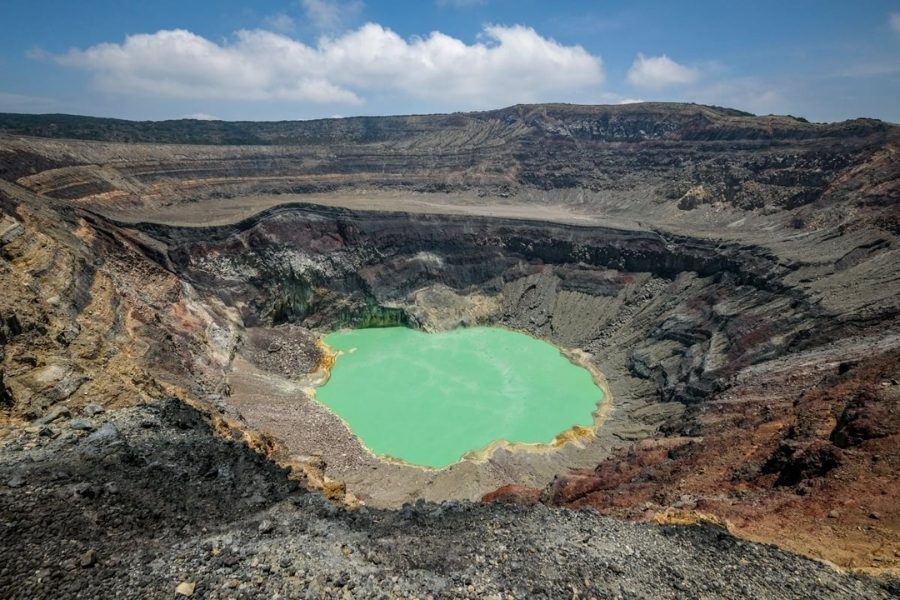
At 2,381 metres, Ilamatepec — the name Salvadorans still use for Santa Ana Volcano — holds a crater lake that steams turquoise and sits closer to battery acid than to rainwater on the pH scale. That lake is why most people climb, and it is also why the Santa Ana Volcano hike difficulty question gets asked so often: the reward waits at the top of a slope of loose volcanic gravel, exposed to whatever weather the summit happens to be holding. The route begins inside Cerro Verde National Park, under cloud forest, and ends on bare tephra. Two landscapes, one morning. Numbers quoted online disagree because walkers measure from different places. From the Cerro Verde car park the path sets off near 1,900 metres and finishes at the 2,381-metre rim, which puts the vertical gain at roughly 500 metres across about 3.5 kilometres in each direction. That is a steady gradient rather than a scramble. There is no rope work and no technical section. What tires people on the Volcán de Santa Ana climb is the surface. The upper switchbacks cross scree that slides underfoot, and the final ridge carries no shade at all. Ascent times of ninety minutes to two hours are normal, followed by a quicker but less stable descent. Guides commonly allow three to four hours for the round trip, including time spent at the rim. Anyone stopping for the views over Lake Coatepeque, the Izalco cone and the Cerro Verde caldera will take longer, and that is the usual pattern rather than a shortfall. Safety on the mountain is managed collectively. Groups walk with park guides and, in most seasons, an accompanying tourist police unit, and they set off together rather than trickling up the cone alone. The system exists for practical reasons. The crater rim is unfenced, the drop toward the lake is sheer, and sulphur dioxide drifts across the summit when the wind swings. Nothing is sold along the route, and there is no shelter of any kind above the treeline. The volcano last erupted in October 2005, and it remains monitored, so trail closures can be announced at short notice. Cloud typically builds over the summit from late morning, which is why the recommended arrival window sits between 08:00 and 10:00, and why the park stops sending walkers up long before its 16:00 close. The verdict is best read as a threshold rather than a warning. Most reasonably active adults, including teenagers and walkers in their sixties, reach the rim without drama; those who struggle are usually the ones who started late, carried too little water, or underestimated the equatorial sun at altitude. Anyone with knee trouble should think hardest about the way down, where the gravel does the deciding. Read honestly, the Santa Ana Volcano hike difficulty rating lands on moderate: demanding enough to respect, modest enough to plan around in a single morning. Guided Cerro Verde volcano hikes remove most of the logistics, and the timing, checklist and cost sections elsewhere on this site fill in the practical detail before a place is reserved.
“The gradient is not what tires people on Ilamatepec — the gravel is.”
This walkthrough breaks the Santa Ana Volcano climb into its physical stages, from the flat opening kilometres to the loose scree of the final push and the descent back down. Most hikers spend roughly three and a half to five hours on the trail round trip, depending on pace and how often the group stops.
The route climbs roughly 500 metres over about 4 kilometres each way from the Cerro Verde trailhead, so anyone comfortable with an hour of continuous uphill walking can complete it. The common mistake is assuming a short distance means an easy hike — the difficulty lives in the sustained gradient, not the kilometres.
The first stretch crosses coffee plantations and open farmland on gentle, mostly level ground, which is the moment to settle into a rhythm. Hikers routinely burn energy racing ahead here and then struggle once the incline starts.
The trail narrows and steepens through shaded woodland, with uneven dirt, exposed roots, and rock steps that force you to watch your footing. Shorten your stride rather than speeding up, because the grade tightens further ahead.
Above the treeline the surface turns to loose black gravel and broken rock with no shade and little handhold. Plant each foot deliberately and expect some backward slide; pushing off hard on loose stone is what causes most slips.
The crater edge is exposed, windy, and drops away sharply on the inner side. Stay behind marked boundaries and keep clear of the lip when taking photographs.
Coming down the scree is faster but harder on knees and ankles, and it accounts for most minor injuries on this trail. Lean back slightly, keep your weight over your heels, and allow at least half the time you spent climbing.
The best arrival window is 08:00–10:00 to mitigate hike difficulty by avoiding peak afternoon heat and cloud cover. Early starts provide cooler temperatures and more stable conditions for the ascent.
Clear skies, 20–25°C
Ideal visibility for crater views. High volume of visitors on Saturdays and Sundays.
Afternoon showers, 18–23°C
Expect clouds by midday. Trail conditions may be muddy after rain.
—
Most manageable rhythm for hikers. Arriving early ensures cooler air and fewer trail bottlenecks.
Verdict: The best time to visit is on a weekday between 08:00 and 10:00 during the dry season months of November to April.
The volcanic terrain on this hike demands specific footwear, water supplies, and protective layers, so assemble your kit in the days before you set out.
The Santa Ana Volcano is open for hiking daily throughout the week. Access remains consistent across all seven days to accommodate visitors.
Everything you need to know about santa ana volcano hike difficulty
The santa ana volcano hike difficulty is generally considered moderate, involving a steady incline over rocky terrain. Hikers should be prepared for a consistent ascent that lasts approximately one to two hours depending on your pace.
The trail is accessible for most active individuals, though the steep sections can be demanding. Evaluating your own fitness against the santa ana volcano hike difficulty ensures a more enjoyable experience for those new to high-altitude trekking.
This ascent requires decent cardiovascular stamina as the trail gains significant elevation quickly. Recognizing the santa ana volcano hike difficulty helps visitors prepare appropriately for the thin air and sustained effort needed to reach the summit.
The journey to the top typically takes between 60 to 90 minutes for an average hiker. Completing this El Salvador landmark excursion is manageable if you maintain a steady, controlled rhythm.
There are no strict age limits, but the trek is physically taxing and may not be suitable for small children or those with health conditions. It is important to assess your party's readiness before attempting the crater climb.
Clouds and rain can make the path slippery, which increases the santa ana volcano hike difficulty during the wet season. Arriving early is recommended to navigate the sulfur-rich volcanic landscape before afternoon conditions change.
Access to the park requires a conservation fee of 6 USD per person for foreign visitors. This contribution supports the maintenance and safety of the Cerro Verde National Park region.
While local requirements may change, guided group access is standard for managing safety and trail traffic. Following local regulations ensures you receive necessary updates on current path conditions.